
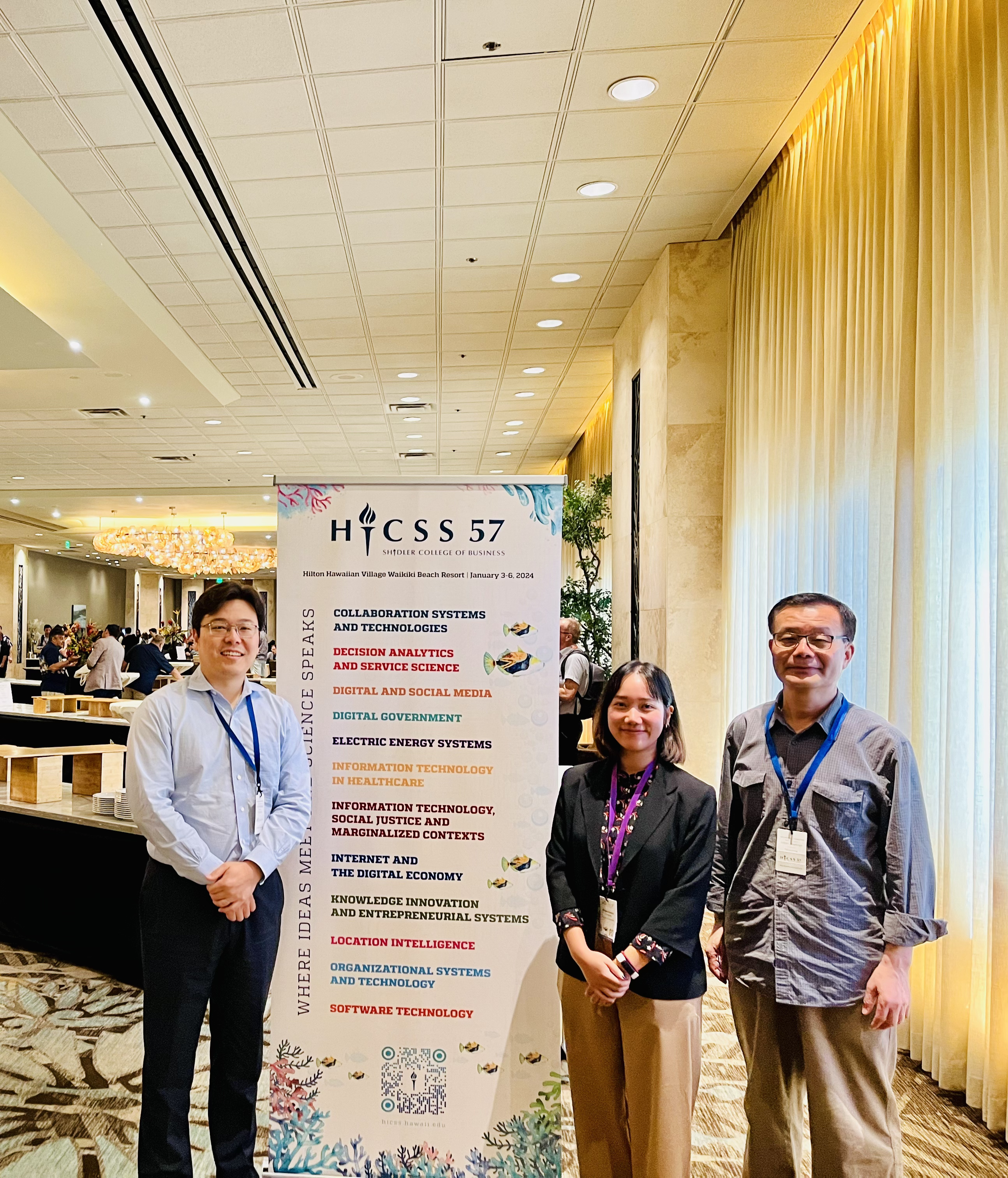
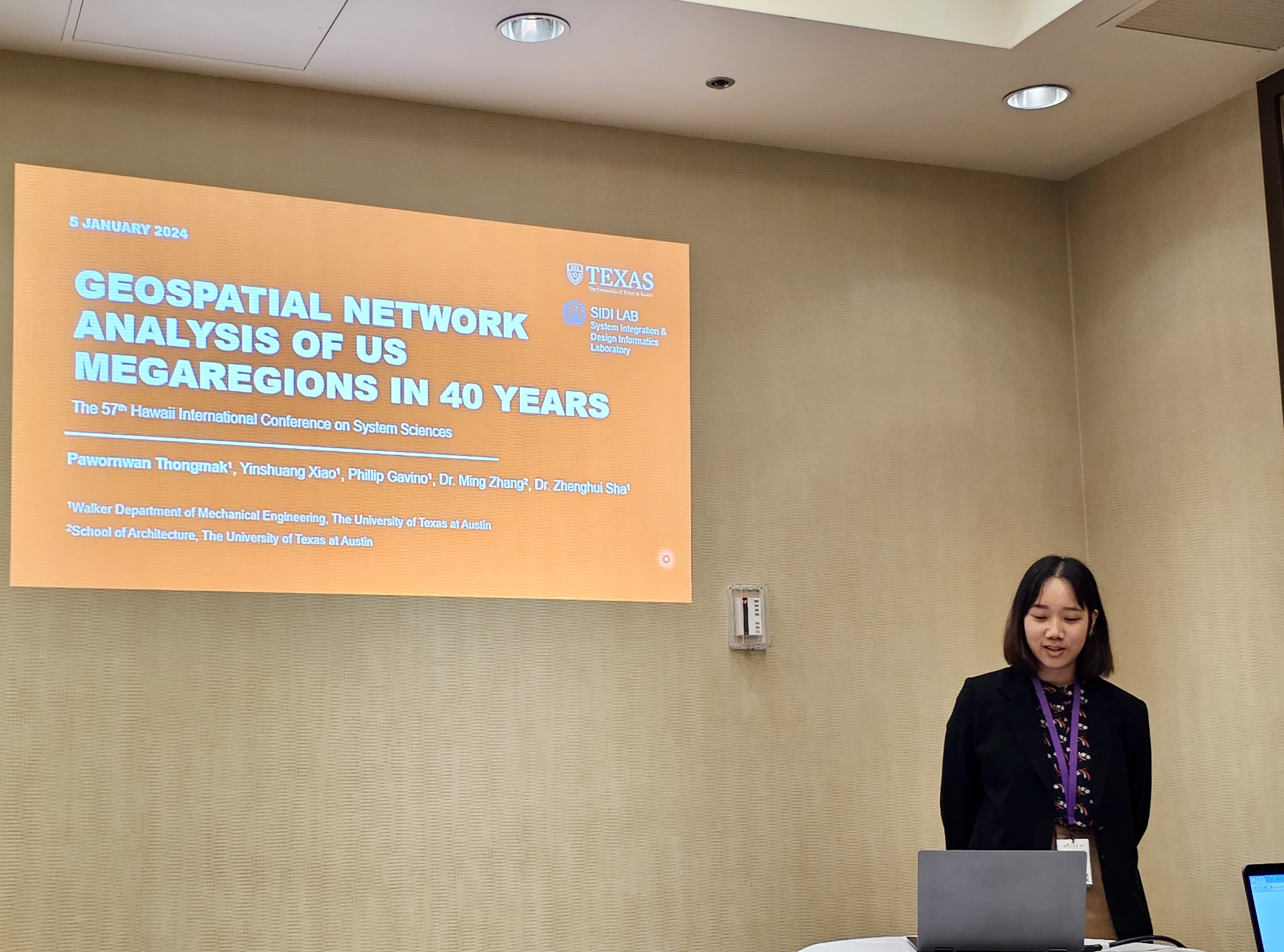
Dr. Zhenghui Sha and the PhD student Pawornwan Thongmak attended the 57th Hawaii International Conference on System Sciences (HICSS) and presented the work, Geospatial Network Analysis of US Megaregions in 40 Years, led by the authors, P. Thongmak, Y. Xiao, P. A. Gavino, M. Zhang, and Z. Sha. By collaborating with Dr. Ming Zhang, the Director of Cooperative Mobility for Competitive Megaregions (CM2) (a University Transportation Center (UTC) at UT Austin funded by the Department of Transportation), we use network analysis approaches and models to gain insights into the evolution of megaregions, complex urban systems that “contain two or more roughly adjacent urban metropolitan areas that, through commonality of systems—of transport, economy, resources, and ecologies—experience blurred boundaries between the urban centers, such that perceiving and acting as if they are a continuous urban area is, for the purposes of policy coordination, of practical value” [Defining U.S. Megaregions].
In particular, this paper proposes a network analysis framework based on geographic information systems (GIS) to study the development of megaregions in support of urban planning and policy-making. The framework includes a new approach to model geo-shaped polygon data of census places as the Place Geo-Adjacency Network (PGAN). In particular, the integration of descriptive network analysis and degree distribution analysis supports the study of spatial connections, geospatial growth, hub effects, and expansion patterns in megaregions. To demonstrate this framework, a case study was conducted on four US megaregions to study their growth and expansion in the last 40 years since 1980. The degree distribution analysis captures the small-world property and quantifies the level of geospatial connectivity influenced by the hub effects. Policymakers can use the model as a decision support for urban planning and policy design to reduce disparities and improve connectivity in megaregion areas.

 SiDi LAB | Discover More