
Agenda
Date: Friday, December 13th, 2024, from 9:30 AM to 3:45 PM Central Time (10:30 AM – 4:45 PM Eastern Time). The schedule below follows Central Time.
- Presentations from 9:30 AM – 2:30 PM
- Lunch from 12:00 – 1:30 PM
- Roundtable Discussion and Closing Remarks from 2:30 – 3:45 PM
9:30 – 2:30 PM: Panelist Presentations & Lunch; times subject to change
- Meeting Kickoff (9:30 – 9:45 AM) – Dr. Zhenghui Sha
- Presentation 1 + Q&A (9:45 – 11:00 AM) –
- Dr. Molly H. Goldstein and Dan Banach (presentation title: Generative Design: Fusion Advancements and Applications in the Classroom), and
- Aiden Hall (Generative vs. Traditional Computer-Aided Design: How design tools impact CAD artifact quality)
- Break (11:00 – 11:15 AM)
- Presentation 2 + Q&A (11:15 AM – 12:00 PM) – Yuewan Sun: (Leveraging LLMs for Data-Driven Generative Design)
- 12:00 – 1:30 PM: Lunch at CAVA (tentative)
- Presentation 3 + Q&A (1:30 – 2:30 PM) –
- Dr. Charles Xie (The Aladdin Platform for Design Research), and
- John Clay: (Generative Design Thinking: Theory, Education, and Dissemination)
2:30 – 3:30 PM: Roundtable Discussion (Topic: Human-Centered Generative Design)
3:30 – 3:45 PM: Closing Remarks
Meeting Location and Link
In-person meeting: ETC 5.224. The Education Teaching Center (ETC) building is located at 204 E Dean Keeton St, Austin, TX 78712.
Virtual meeting (Zoom): https://utexas.zoom.us/j/98637685564
Resources
- EDGE 2024 Kick-off slides (uploaded soon!)
- EDGE 2024 Executive Summary
- EDGE 2024 Research Report
- EDGE 2024 Roundtable Discussion Questions (uploaded soon!)
- Formal Summary: Generative Design in Engineering Research and Education Workshop
- Webpage: Generative Design in Engineering Research and Education Workshop
- EDGE NSF Award Page
- Educating Designers for Generative Engineering (EDGE) Proposal
- Design Curriculum Materials
Year 5 Key Project Outcomes
Outreach & Broader Impacts
- Collaborated with industry partners PTC, Inc. to host the Generative Design in Engineering Research and Education Workshop to disseminate project materials (Workshop Summary).
- Broadened dissemination of project materials including Aladdin and Fusion360 curriculum materials, engineering education research to explore generative design thinking, and exploration of multimodal LLMs for 3D CAD generation to major technical and educational conferences as well as peer-reviewed journals (See the Products section of the Research Report for a full list of Year 5 publications).
Education Research
- Development and refinement of curriculum materials in Aladdin and Fusion360 to teach generative design and related concepts (Koolman et al., 2024. A multi-case study of traditional, parametric, and generative design thinking of engineering students).
- Conducted human-subjects data collection to test curriculum materials and explore generative design thinking (Barnaby-Brown et al., 2024. A study on generative design reasoning and students’ divergent and convergent thinking).
- Begun cross-institutional collaboration to conduct educational research using project educational materials.
Generative Design Technology Development
- Updated the cloud-based, open-source, generative design equipped Aladdin to improve performance and add new features (https://intofuture.org/aladdin.html).
- Development of data-driven methods for the realization of generative design in support of software development (Li et al., 2024. LLM4CAD: Multi-Modal Large Language Models for 3D Computer-Aided Design Generation).
* For more information on the project activities and projects, please refer to the EDGE 2024 Research Report.
** For the previous two year’s major activities and products generated from this project, please refer to the EDGE 2023 Research Report and the EDGE 2022 Research Report.
Panelists
Principal Investigator
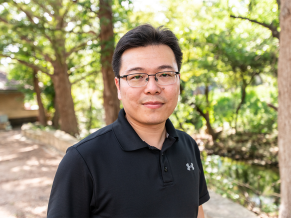
Dr. Zhenghui Sha
Biography: Dr. Zhenghui Sha is an Assistant Professor in the Walker Department of Mechanical Engineering at the University of Texas (UT) at Austin, where he has been since 2021. Dr. Sha received a Ph.D. from Purdue University, an M.S. from Xi’an Jiaotong University, and a B.S. from the Xi’an University of Technology, all in Mechanical Engineering. He is the founder and Principal Investigator of the System Integration and Design Informatics (SiDi) Laboratory. Dr. Sha’s research focuses on system science, design science, and the intersection between these two areas. His goal is to build the decision-centric science foundation for complex systems engineering and design, which will facilitate the integration within complex systems and amplify the data-driven power in engineering design and design research.
Co-Principal Investigators

Dr. Darya L. Zabelina
Biography: Dr. Darya L. Zabelina is an Assistant Professor of Psychology at the University of Arkansas in the Department of Psychological Science, where she has been since 2017. Dr. Zabelina received a Ph.D. in Cognitive Neuroscience from Northwestern University, an M.S. in Experimental Psychology from North Dakota State University, and a B.A. in Psychology from North Dakota State University. She is the founder and Principal Investigator of the Mechanisms of Creative Cognition and Attention (MoCCA) Laboratory. Dr. Zabelina’s research focuses on understanding creative cognition, imagination, and other related processes and how these processes are linked with more traditional sub-fields of cognitive psychology, such as attention and executive functions. Dr. Zabelina’s MoCCA laboratory has the long-term objective to create a theoretical foundation upon which to develop methods to enhance creative thinking, imagination, and problem-solving abilities.

Dr. Molly H. Goldstein
Biography: Dr. Molly H. Goldstein is a Teaching Assistant Professor in Industrial and Enterprise Systems Engineering at the Grainger College at the University of Illinois Urbana-Champaign, where she has been since 2018. Dr. Goldstein received a Ph.D. in Engineering Education from Purdue University, an M.S. in Systems and Entrepreneurial Engineering from the University of Illinois Urbana-Champaign, and a B.S. in General Engineering from the University of Illinois Urbana-Champaign. She is also the Director of the Product Design Laboratory. Dr. Goldstein’s research focuses on student designer trade-off decisions through the study of their design actions and thinking. Her studies often involve educational and professional contexts with cross-disciplinary collaborations. Prior to pursuing her Ph.D., she worked as an environmental engineer specializing in air quality, influencing her focus on engineering design with environmental concerns.

Dr. Onan Demirel
Biography: Dr. Onan Demirel is an Assistant Professor of Mechanical Engineering at Oregon State University, where he has been since 2016. Dr. Demirel received a Ph.D, M.S., and B.S. in Industrial Engineering from Purdue University. He is a member of the Design Engineering Laboratory, which is the largest academic mechanical engineering design research laboratory in the US. Dr. Demirel’s research interests lie at the intersection of human factors engineering, engineering design, and systems engineering. His research focuses on understanding human elements in the design process, making advances in Digital Human Modeling theory and practice, and developing multi-disciplinary design theory and methods to explore inter-dependencies and co-evolution of the human element in engineering systems.

Dr. Charles Xie
Biography: Dr. Charles Xie is the founder, President, CEO, and Chief Scientist of the Institute for Future Intelligence, where he has been since 2020. Prior to this, he was the Principal Investigator at the Concord Consortium from 2000 to 2020. Dr. Xie received a Ph.D. in Materials Science from the University of Science and Technology Beijing, an M.S. in Physics from Xiamen University, and a B.S. in Mechanical Engineering from Nanjing University of Aeronautics and Astronautics. Dr. Xie has over 25 years of experience in STEM research and education and has authored or co-authored 64 peer-reviewed journal papers. His current work is focused on evolutionary computation algorithms that can be used to create artificially intelligent design tutors embedded in CAD and CAE software. He is also the creator of Aladdin, Energy2D, iFlow, Infrared Explorer, and Quantum Explorer and a co-developer of Infrared Street View and Telelab.
Advisory Board

Dan Banach
Biography: Dan Banach is a Senior Technical Manager at Autodesk, Inc., where he has been for over a decade. Mr. Banach is a nationally recognized expert in Mechanical Computer-Aided Design and has authored 25 books on the Autodesk 3D mechanical design software. Mr. Banach received a B.S. in Industrial Technology from the University of Wisconsin-Stout.

Dr. Lydia Chilton
Biography: Dr. Lydia Chilton is an Assistant Professor of Computer Science at Columbia University, where she has been since 2017. Dr. Chilton received a Ph.D. in Computer Science from the University of Washington, an M.Eng. from the Massachusetts Institute of Technology, and a B.S. in Computer Science from MIT. Dr. Chilton’s research focuses on human-computer interaction within computational design. She is the Principal Investigator of the Computational Design Laboratory, which has the goal of building AI tools to enhance human productivity.

Dr. Yan Fu
Biography: Dr. Yan Fu is a Senior Director in Strategy and Enterprise Analytics at Ford Motor Company, where she has been for over two decades. Dr. Fu received a Ph.D. in Civil and Environmental Engineering from Carnegie Mellon University, an M.S. in Environmental Engineering from the Chinese Academy of Sciences, and a B.S. in Environmental Engineering from Tsinghua University. Dr. Fu’s research is focused on AI and advanced optimization technologies, and her work has resulted in 2 US patents, 4 Ford Trade Secrets, and 1 Defensive Publication. She is also a SAE Fellow and an ASME Fellow.

Dr. John Gero
Biography: Dr. John Gero is a Research Professor in Computer Science and Architecture at the University of North Carolina at Charlotte, where he has been since 2012. Dr. Gero received a Ph.D. from the University of Sydney, an M.S. in Building Sciences, and a B.A. in Engineering from the University of New South Wales. He is a member of the Charlotte Neuro-Cognitive Interaction Laboratory, which investigates the neurological mechanisms involved in computing-related tasks. Dr. Gero’s research spans many disciplines, including design science, design computing, AI, computer-aided design, design cognition, and design neurocognition. Dr. Gero has authored over 50 books and over 750 papers throughout his career and is a leading figure in design research.

Susan Shaw
Biography: Susan Shaw is a Customer Research Lead in Advanced Driver-Assistance Systems at Ford Motor Company and was previously a Senior Engineer at the Hyundia-Kia America Technical Center, Inc. Ms. Shaw received an M.S. in Industrial and Operations Engineering from the University of Michigan and B.S. in General Engineering and Biomedical Engineering from the University of Illinois Urbana-Champaign. Her research focuses on the human-machine interface and usability of vehicle systems.

Rachel Switzky
Biography: Rachel Switzky is an Assistant Professor at the University of Illinois Urbana-Champaign and the director of the Siebel Center for Design. Previously, she was an Executive Director of Business Strategy at IDEO for over a decade. Ms. Switzky received a B.F.A and an M.F.A from the University of Illinois Urbana-Champaign, both in Industrial Design. Her research focuses on human-centered design curriculum and education. Ms. Switzky is also a member of the Molecule Maker Laboratory Institute, an interdisciplinary collaboration that utilizes advanced AI and machine learning methods to conduct molecular research.

