LLM4CAD: Leveraging LLMs to Speedup CAD Generation

3D computer-aided design (CAD) models are essential to many engineering simulation and analyses, such as finite element analysis (FEA). We (work led by Dr. Xingang Li and the PhD student, Yuewan Sun) recently explored the potential and capabilities of leveraging LLMs to directly generate 3D CAD models from various design modalities, including text, sketches, and images. We published a series of two articles on these LLM4CAD methodologies in the ASME Transactions: https://doi.org/10.1115/1.4067085 and https://doi.org/10.1115/1.4067713.

In the first paper, we utilized LLM as both a generator and debugger to iteratively improve CAD program generation for 3D models. We examined the relationship between part complexity and LLM4CAD performance (e.g., intersection over union (IoU) of the generated 3D shapes). In the second paper, we fine-tuned four small models using different data sampling strategies based on the length of a CAD program. Our study compared these models with one another and also with GPT-4 without fine-tuning. The insights gained can guide the selection of sampling strategies for building training datasets in the fine-tuning practices of LLMs for text-to-CAD generation, while considering the trade-off between part complexity, model performance, and cost. Additionally, we tested the generalizability of our methodology on more complex, real-world mechanical components drawn from the ABC dataset. We open-sourced our LLM4CAD dataset at the Texas Data Repository as part of a recent initiative led by the special issue “Design by Data: Cultivating Datasets for Engineering Design” from the Journal of Mechanical Design.

FIRE Program’s Winning Project: Swarm Manufacturing with Robotics

In Fall 2024, SiDi Lab hosted a group of three freshmen students, Ian Clark, Parth Mehta, and Retvin Pant, through the Freshman Introduction to Research in Engineering (FIRE) program at the Walker Department of Mechanical Engineering. Their project, “Swarm Manufacturing with Robotics,” mentored by PhD student Ronnie Stone, won first place in the final design competition. In this project, the team designed a novel fused deposition modeling (FDM) extruder system for robotic arm-enabled 3D printing, building an important link in realizing swarm-inspired hybrid manufacturing. Congratulations to the team for their impressive work, as they just joined UT ME for the first semester! Check out the demo below and stay tuned for our next design iteration.

CAD Informatics for Design | IDETC/CIE 2024 Workshop

Dr. Sha is invited to give a presentation on a workshop, “The Trove of CAD Informatics: Acquiring and Analyzing CAD Data for Design Process Insights and AI Applications,” at the 2024 IDETC/CIE conference. He will present SiDi Lab’s most recent work on cross-modal synthesis for 3D computer-aided design (CAD) generation. He will also join a panel discussion session and share his thoguths on how CAD informatics can support design research and design education.

Some relevant papers related to the presentation given are:

X. Li, Y. Sun, Z. Sha, “LLM4CAD: Multi-Modal Large Language Models for 3D Computer-Aided Design Generation,” ASME 2024 International Design Engineering Technical Conferences & Computers and Information in Engineering Conference, Washington DC, Aug. 25-28, 2024.

X. Li, Y. Wang, Z. Sha, “Deep-Learning Methods of Cross-Modal Tasks for Conceptual Design of Product Shapes: A Review,” Journal of Mechanical Design, volume 145, issue 4, pp: 041401 (20). DOI:  https://doi.org/10.1115/1.4056436.

X. Li, C. Xie, Z. Sha, “A Predictive and Generative Design Approach for 3D Mesh Shapes Using Target-Embedding Variational Autoencoder“, Journal of Mechanical Design, Transactions of the ASME, volume 144, issue 11, pp: 114501 (7). DOI: https://doi.org/10.1115/1.4054906.

Comparing Generative, Parametric, and Traditional Design Thinking in Engineering Education

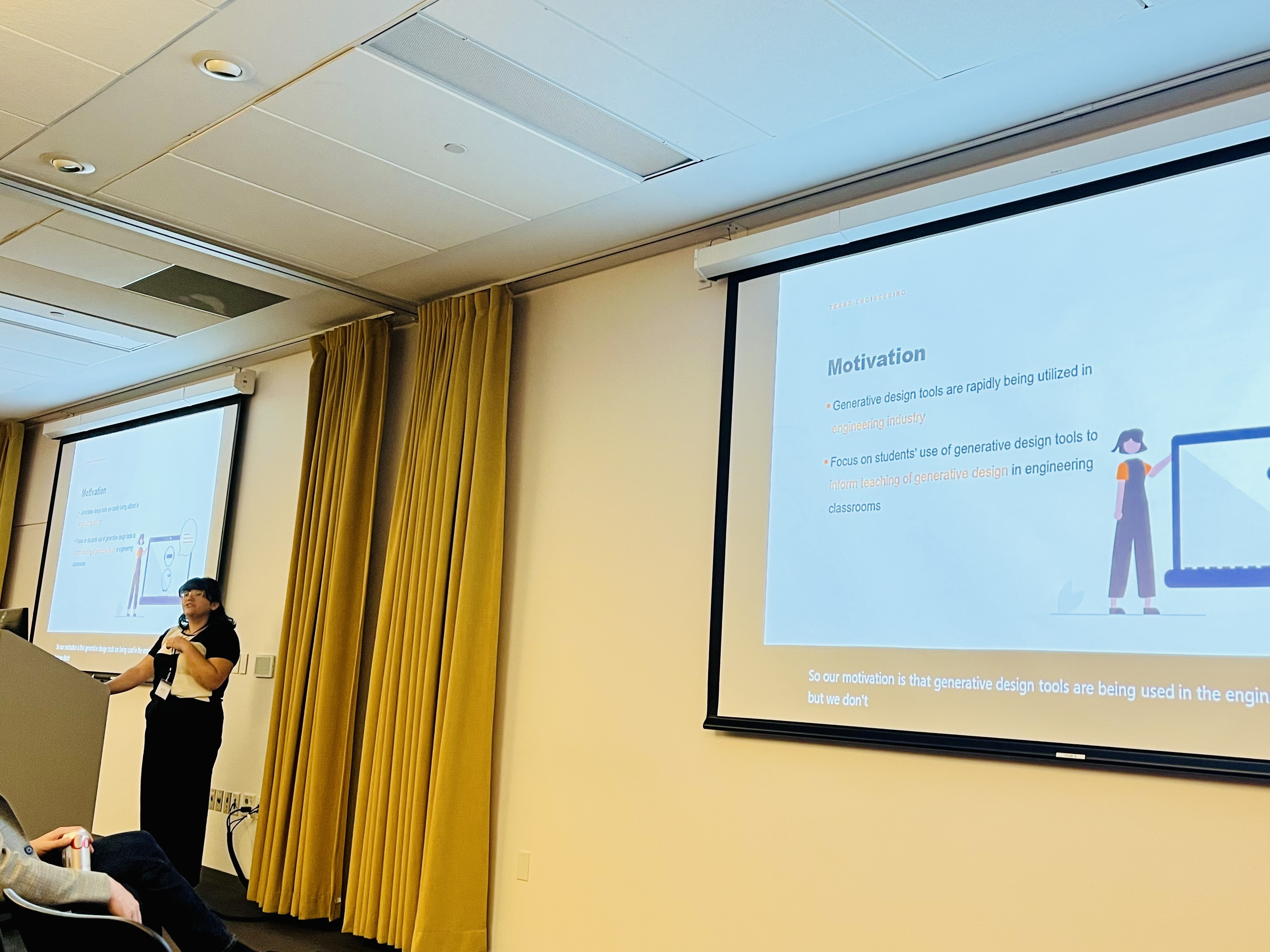
Elisa Koolman, a PhD student co-advised by Dr. Sha and Dr. Maura Borrego, recently presented our paper on “A multi-case study of traditional, parametric, and generative design thinking of engineering students.”

Abstract: The recent surge in generative artificial intelligence (AI) applications within engineering design requires equipping future engineers with the skills to effectively utilize these advanced design tools. Understanding how students think about generative AI in design is pivotal in shaping engineering design education. This study aims to explore mechanical engineering students’ perceptions and approaches to generative design (GD) compared to parametric design (PD) and traditional design (TD). To achieve this, a comprehensive curriculum encompassing these three design paradigms was developed and administered to seven undergraduate mechanical engineering students. Students engaged with the curriculum activities while their responses and interactions were recorded using a verbal protocol. Three students were selected for an in-depth multi-case study analysis. The qualitative and quantitative findings suggest that students’ thought processes and behaviors in GD are influenced and informed by their experiences and understanding of TD and PD.