
Instructions
Download this document and answer the questions in it. Then, upload your answers to Box.
Remember to anonymize your submission. Your file name should contain only your Participant ID Number and the section number. For example, if your Participant ID Number is 103, your file name should be “SFD21_P103.docx.” Note that “SFD” stands for “Solar Farm Design.” Section 2.1 is abbreviated as 21. “P” stands for “Participant.”
Click here to return to Section 2.1 in the textbook.
Click here for Aladdin Reference Slides.
Practice Example: Solar Farm Design
We can also define the design of solar farms with a few variables:
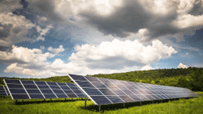
● Tilt angle: How the solar panel is oriented in the vertical direction. An appropriate tilt angle orients a solar panel towards the Sun.
○ 0º = flat (parallel to the ground)
○ 90º = vertical
○ In the photo on the right, the front panels have a lower tilt angle, and the back panels have a higher tilt angle

● Row width: Each row of solar panels may have multiple sub-rows. A wider row casts a
longer shadow.


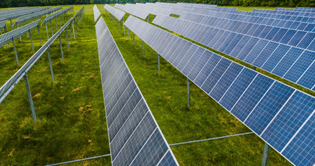
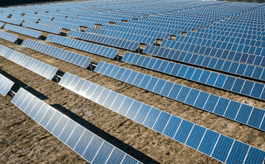
- Because most solar farm designs follow a similar pattern, we can define another variable called “inter-row spacing”. Look at the two examples below:
● Can you provide a definition for “inter-row spacing”?
| Definition of inter-row spacing (IRS) | |
2. Imagine you have sketched the solar farm design shown below:
● The width of the field is approximately 50m.
● There are 8 rows of solar panels, equally spaced throughout the field
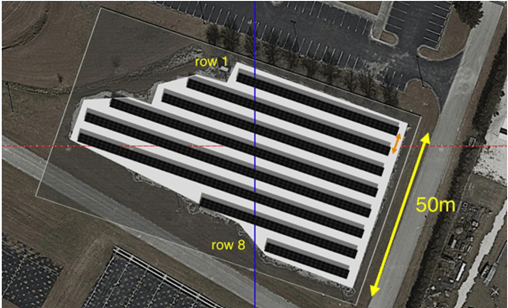
Now you need to calculate the parameters of this design:
- Can you calculate the approximate inter-row spacing of this design? (Assume the IRS is measured center-to-center, not edge-to-edge, see the orange arrow in the above figure.)
- Now that you know the IRS, can you describe a way to calculate the position of each solar panel row using its row number (1-8) and IRS? Feel free to respond with text, pseudo code, or any other format.
 SiDi LAB | Discover More