
Instructions
Download this document and answer the questions in it. Then, upload your answers to Box.
Remember to anonymize your submission. Your file name should contain only your Participant ID Number and the section number. For example, if your Participant ID Number is 103, your file name should be “SFD13_P103.docx.” Note that “SFD” stands for “Solar Farm Design.” Section 1.3 is abbreviated as 13. “P” stands for “Participant.”
Click here to return to Section 1.3 in the textbook.
Click here for Aladdin Reference Slides.
Practice Example: Solar Farm Design
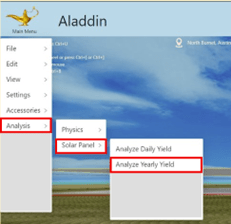
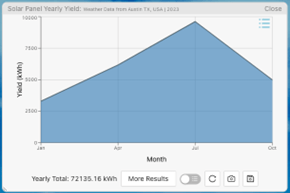
3. Take this chance to evaluate the two solar farm designs you generated earlier. Follow the instructions to analyze each design and record the results in the table below.
| Design 1 | Design 2 | Design 3 | |
| Variable: Tilt angle | small | large | [Insert your own design choices] |
| Variable: Spacing | small | large | [Insert your own design choices] |
| Screenshot | 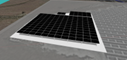 | ||
| Objective: Yearly total output (kWh) | 72135.16 | ||
| Objective: Yearly average output (kWh) | 429.38 | ||
| Objective: Total cost ($) | 9198 | ||
| Objective: Profit ($) | 1622.27 |
4. Map the three designs onto the objective space below. Design 1 (high energy output and
high cost) has already been provided as an example.

Now that we have evaluated all three designs, are we ready to declare which is better? Well, not always. For one thing, designs with a higher output tend to use more solar panels, which incur a higher cost by nature. Fortunately, there are often multiple objectives or metrics, with which to evaluate the designs. In the case of solar farm design, Aladdin also provides additional analysis results, including:

● Yearly Profit = Total Revenue – Total Cost
● Yearly Average Output (or Mean Yield) = Yearly Total Output / Module Count
5. Map the three designs onto a different objective space below, including design 1. Since the objectives have changed, be aware that their relative positions may change as well.

6. Which design has the most profit (and is therefore non-dominated)?
7. Which design has the most yearly average output (and is therefore also non-dominated)?
8. Are the remaining designs non-dominated (i.e., better in at least one objective than any other design)? Or are they dominated by any design?
 SiDi LAB | Discover More