Our paper titled “Robust design of complex socio-technical systems (STS) against seasonal effects: a network motif-based approach” is now published on Design Science. In this paper, we developed a design approach to robust STS by modeling complex systems as complex networks and investigating the significant motifs within the network. The network motifs are critical building blocks of the target system and the motif-based design for desired system property provides a new perspective on the STS engineering and design. Check here to read our article: https://www.doi.org/10.1017/dsj.2021.27.
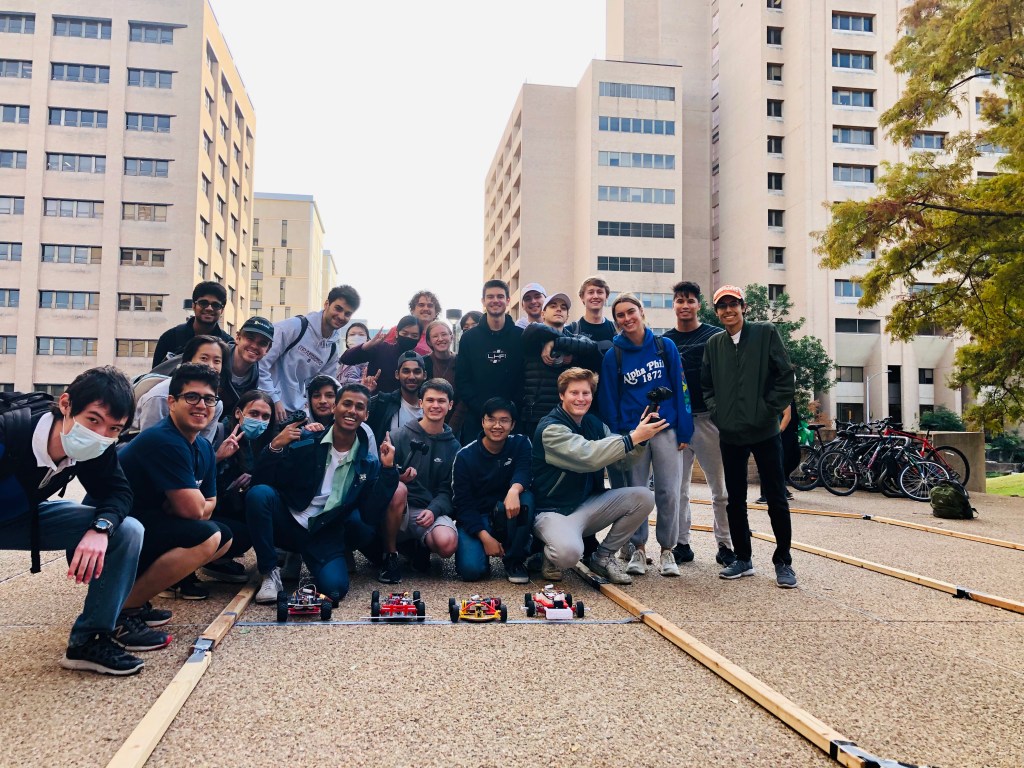
Fall 2021 has been a really hectic semester, especially for teaching. The shift of teaching mode from virtual to in-person (most professors had to take care of both in-person and virtual classes simultaneously) made the teaching schedule and in-class instruction a challenging task. You must prepare for the teaching and tailor the content precisely so that you can finish each lecture in time. I was grateful for the teaching arrangement because I was assigned to teach Machine Elements – a core course in Mechanical Engineering – that I have taught for more than four years. While I am familiar with the course content, this is the first time I changed the course project to a semester-long project – Design and Fabrication of a Remote-Control Car, developed by Dr. Michael Cullinan – my colleague at UT. My previous version has two small projects, each lasting about a half-semester. Of course, it is a challenging task for the students as the time management required to successfully finish this project while still maintaining every course assignment, such as homework and exams, on track is non-trivial.
In this project, each team was given an electrical start kit consisting of a DC motor, a Servomotor, a speed controller, a remote control, a radio receiver, and a battery. Then, each team was responsible for designing the mechanical systems, including the steering system, the gear train, and the chassis, integrating those electrical components, and delivering an RC car for racing. I was impressed to see how my students were adaptive to the changing environment (keep in mind that we are still in the pandemic) and the uncertainties that the students must address because the project itself is pretty open-ended. I was also impressed by the learning outcomes that this project empowered, particularly the systems thinking skills (e.g., the ability to account for interactions between design variables or subsystems and the mindset of taking green and economic factors beyond technical details) and communication skills, including leadership. This made every student a careful observer of the connection between theories and real-world tests and a fast learner from mistakes. These skills are so critical to their future career once they graduate from college. I am sharing a few photos and a video. Feel free to contact me if you are interested in this project, and I’d love to share my teaching experience.
Please join me to congratulate Laxmi Poudel for being offered a Postdoctoral Fellow position at the University of Michigan in Dr. Dawn Tilbury‘s lab. Dr. Tilbury is a well-known professor in the area of control and manufacturing systems. This must be a great opportunity for Laxmi while he is pursuing his career goals in academia. All the best, Laxmi! We wish you all the success in the future endeavor, and your connection to SiDi Lab will continue as I believe this is your academia HOME.
Laxmi joined SiDi as a Ph.D. student at the University of Arkansas in 2017. His research was focused on Cooperative 3D Printing and Scheduling. His research has laid down the foundation for the realization of the swarm manufacturing of the future. His dissertation can be downloaded here, “Computational Frameworks for Multi-Robot Cooperative 3D Printing and Planning.”
It is special summer season for me this year. Not only I am closing my chapter at the University of Arkansas and start a new chapter at the University of Texas at Austin, both both my first PhD student, Laxmi Poudel and my first Master student Jared Pow both graduated this summer. Congratulations, Laxmi and Jared!
Laxmi’s research is focused on cooperative 3D printing and scheduling. His research has laid down the foundation for the realization of the swarm manufacturing of the future. In his dissertation, Laxmi developed the computational frameworks that enables the key technologies for task division, manufacturing scheduling, and multi-robot path planning in cooperative 3D printing. Check his dissertation HERE for more detail.
Jared’s research is focused on computer vision of thermal imaging. Particularly, his Master thesis contributed the knowledge in understanding the limitation and advantages for material detection using thermal imaging, compared to traditional computer vision techniques that heavily rely on RGM images. Jared is now working at L3 Technologies as a Mechanical and Testing Engineer. Check his Master defense presentation below and the thesis HERE for more detail.
It was a great memory working with both talented students and I wish them all the best in their future endeavors!
I’m very excited to share with you, my friends and colleagues, that I’ll be joining The University of Texas at Austin this coming fall in the J. Mike Walker Department of Mechanical Engineering! I see the new opportunities and challenges ahead of me, and I very much look forward to collaborating with you in my future endeavors. Meanwhile, I am extremely grateful to all my colleagues at The University of Arkansas who have provided tremendous support to me during the last four years. The experience in the mechanical engineering department at UARK provided me with a unique opportunity to prepare myself as an educator and create my own identity as an independent researcher in design science and system science. I will miss you all!
Quoted from the Guest Editorial of this special issue “The coordination of autonomous resources within a smart manufacturing enterprise is an important enabler for Industry 4.0. Decentralized cooperative manufacturing for 3D printing results in increased throughput and efficiency but poses new coordination challenges. To address these challenges, Poudel et al. presented a method for scheduling multi-robot cooperative 3D printing in their paper titled “Resource-Constrained Scheduling for Multi-Robot Cooperative Three-Dimensional Printing.” The authors demonstrated the algorithms using different geometrical shapes.”
Our research on Cooperative 3D Printing and Swarm Manufacturing was recently featured over the weekend on CBS’ Innovation Nation! The Ph.D. candidate Laxmi Poudel is a key contributor to this project. Congratulations!
L. Poudel, L. G. Marques, R. A. Williams, Z. Hyden, P. Guerra, O. L. Fowler, S. J. Moquin, Z. Sha, W. Zhou, “Architecting The Cooperative 3D Printing System”, ASME 2020 International Design Engineering Technical Conferences & Computers and Information in Engineering Conference, St. Louis, MO, Aug. 16-19, 2020.
S. Elagandula, L. Poudel, Z. Sha, W. Zhou, “Multi-Robot Path Planning for Cooperative 3D Printing“, The ASME 2020 15th International Manufacturing Science and Engineering Conference (MSEC), June 22-26, 2020, Cincinnati, OH.
The PhD Candidate at SiDi Lab, Laxmi Poudel, has been selected as the recipient of the Excellence in Research Award by the Graduate Professional Student Congress at the University of Arkansas. This award is awarded to one Graduate or Professional student engaged in outstanding academic research, regardless of department, that has caused honor to be bestowed upon said individual and graduate and professional programs at the University of Arkansas within the current academic year through significant contributions to sciences or humanities. Congratulations to Laxmi, and check his recent publications on cooperative and swarm manufacturing.
In this study, we present a data-driven generative design approach that can augment human creativity in product shape design with the objective of improving system performance. The approach consists of two modules: 1) a 3D mesh generative design module that can generate part-aware 3D objects using variational auto-encoder (VAE), and 2) a low-fidelity evaluation module that can rapidly assess the engineering performance of 3D objects based on locally linear embedding (LLE). This approach has two unique features. First, it generates 3D meshes that can better capture surface details (e.g., smoothness and curvature) given individual parts’ interconnection and constraints (i.e., part-aware), as opposed to generating holistic 3D shapes. Second, the LLE-based solver can assess the engineering performance of the generated 3D shapes to realize real-time evaluation. Our approach is applied to car design to reduce air drag for optimal aerodynamic performance.




 SiDi LAB | Discover More